Best Lash Serums 2026: Every Label Checked & Ranked
Of the 12 lash serums we checked on 16 August 2026, seven list a prostaglandin analogue on the label and five do not. That single distinction matters more than any ranking: analogues work faster and carry documented risks including permanent iris darkening, while peptide formulas are gentler and slower.
Every ingredient list read at source and dated · No sponsored placements, ever · Every regulatory claim linked to the primary document · 12 labels checked on 16 August 2026 · Re-checked every 90 days
| 12 | 12 | 5 | 6 |
|---|---|---|---|
| Labels checked | Analogue names screened | Regulators cited | Scoring criteria |
The Ordinary Multi-Peptide Lash and Brow Serum is our top pick at around $20 for 5mL — it publishes its full ingredient list, lists no prostaglandin analogue, and costs a fraction of everything else here per millilitre.
If you want the fastest visible change. GrandeLASH-MD works quicker, and the reason it works quicker is isopropyl cloprostenate — a prostaglandin analogue on Health Canada’s restricted list and named in the EU’s February 2026 safety review. Faster results, documented trade-offs.
If you have blue, green or hazel eyes, are pregnant, or are breastfeeding. Skip the prostaglandin serums entirely. Here’s why your eye colour changes the answer →
Our Picks at a Glance
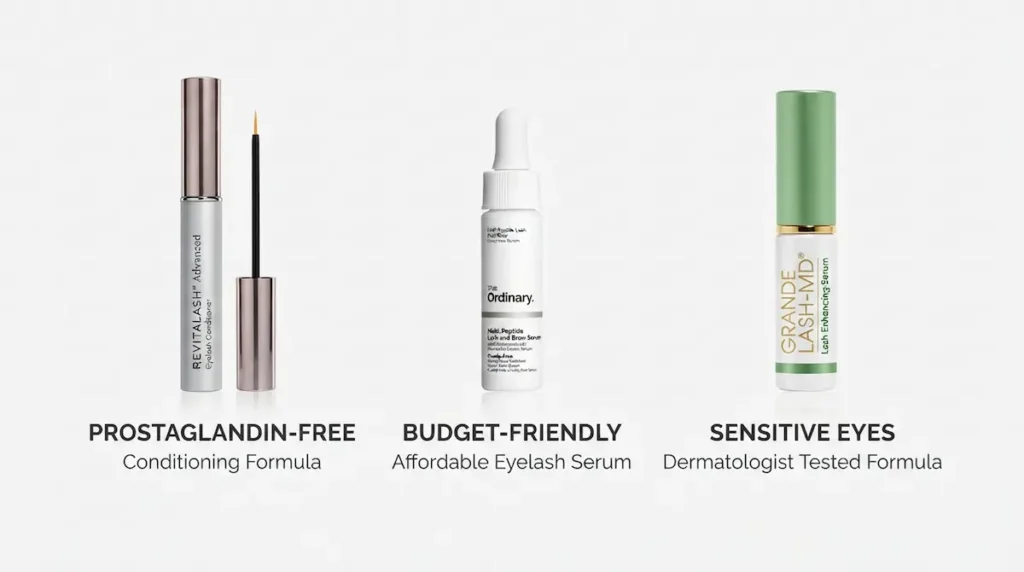
| Category | Product | Price | Status | Why | |
|---|---|---|---|---|---|
| Best overall | The Ordinary Multi-Peptide Lash & Brow | ~$20 / 5mL | 🟢 Green | Cheapest per millilitre here, full INCI published, four named peptide complexes | Jump → |
| Best without prostaglandins | Vegamour GRO Lash Serum | 3mL | 🟢 Green | The only prostaglandin-free pick that publishes both sample size and duration for its results claim | Jump → |
| Best for sensitive or reactive eyes | LashFood Phyto-Medic | $78 / 3mL | 🟢 Green | Alcohol-free and fragrance-free on its own label — a different test from prostaglandin-free | Jump → |
| Best under $30 | The Ordinary Multi-Peptide Lash & Brow | ~$20 / 5mL | 🟢 Green | Nothing else here comes close on cost per millilitre | Jump → |
| Best in drugstores | RapidLash Eyelash Enhancing Serum | 3mL | 🟡 Amber | Genuinely on shelves — but its label lists isopropyl cloprostenate | Jump → |
| Best natural or clean formula | LashFood Phyto-Medic | $78 / 3mL | 🟢 Green | Ecocert certified at 99.49% natural origin — an audit, not a marketing word | Jump → |
| Best for lashes and brows together | The Ordinary Multi-Peptide Lash & Brow | ~$20 / 5mL | 🟢 Green | One formula, both areas, sold as such rather than as two products | Jump → |
| Best at Sephora and Ulta | The Ordinary Multi-Peptide Lash & Brow | ~$20 / 5mL | 🟢 Green | Authorised retail means returns, and it means no counterfeit risk | Jump → |
| Best prescription route | Latisse (bimatoprost 0.03%) | Prescription | 🟡 Amber | The only lash growth product the FDA has approved, with published trial data behind it | Jump → |
| Fastest visible change | GrandeLASH-MD | ~$65 / 2mL | 🟡 Amber | Prostaglandin analogue, and the trade-offs come with it | Jump → |
What Green and Amber mean
🟢 Green — no prostaglandin analogue name appears on the ingredient list we read.
🟡 Amber — an analogue name is listed.
That’s the whole system, and it’s deliberately narrow. These badges describe what a label says, not whether a product is safe or dangerous. Nobody running a website is qualified to issue that verdict, so we don’t. What we can tell you is exactly what’s in the bottle, which name to look for, and where the regulators stand — then the decision is yours.
There Are Only Two Kinds of Lash Serum
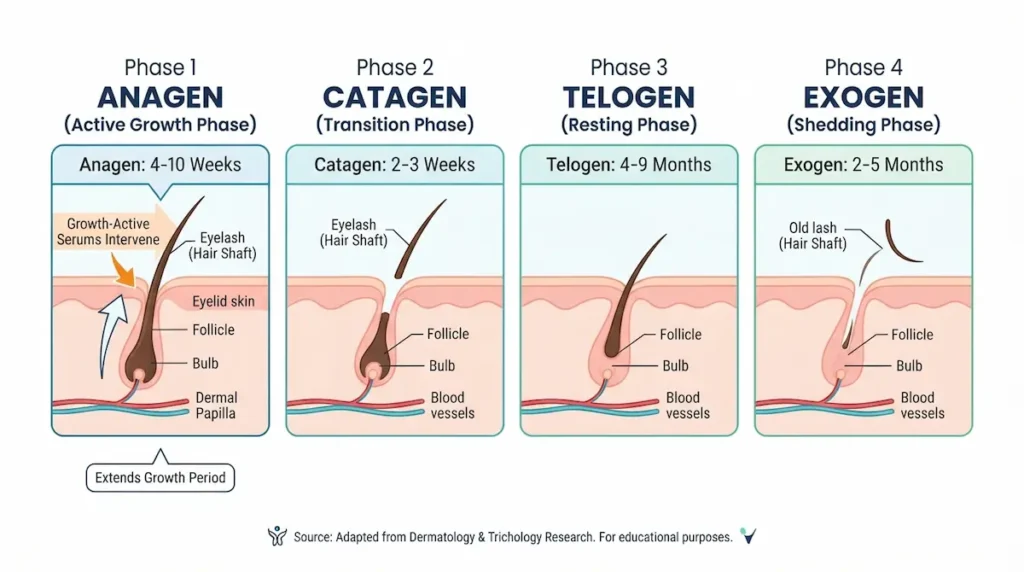
Strip away the packaging and every lash serum sold does one of two things. It either extends the phase in which a lash is actively growing, or it conditions the lash already sitting on your eyelid. Those are different jobs with different chemistry behind them, and knowing which one you’re buying explains almost every disappointment in this category.
Growth-active formulas
An eyelash spends a short window actively growing — the anagen phase — before it stops, rests, and eventually sheds. That window is brief, which is why lashes never reach the length of the hair on your head. Only a minority of your upper lashes are in it at any given moment, and the rest are resting or on their way out.
Growth-active formulas work by holding lashes in that window longer. A lash that stays in anagen for six weeks instead of four is a longer lash when it finally sheds. That’s the entire mechanism, and there are two chemical routes to it.
The first is prostaglandin analogues — isopropyl cloprostenate, bimatoprost, dechloro dihydroxy difluoro ethylcloprostenolamide and their relatives. These are chemical cousins of glaucoma medication, and they act on the follicle directly. They are the fastest route and they carry the documented risks that go with that. What the regulators have said about them →
The second is peptide complexes. Look for Myristoyl Pentapeptide-17, Biotinoyl Tripeptide-1, Acetyl Tetrapeptide-3 and Oligopeptide-2 — the last two often appearing together as Capixyl, paired with red clover extract. The Ordinary’s serum lists four such complexes. Peptides signal to the follicle rather than acting on it pharmacologically, which is why they take longer and why the evidence behind them is thinner. The published studies for these ingredients are mostly manufacturer-run and mostly in-vitro. Worth knowing before you spend.
Conditioning formulas
The second group doesn’t touch the growth cycle at all. Castor oil, coconut oil, topical keratin, petroleum jelly, hyaluronic acid as a lead ingredient, biotin as the headline active — these coat, soften and hold moisture in the lash you already have.
That’s a real benefit. Lashes that bend instead of snapping stay on your eyelid longer, so you see more of them at once and they look fuller. But fuller because fewer are breaking is not the same as longer because more are growing, and the two get sold as though they were.
None of this is unsafe. Conditioning ingredients are the gentlest things in the category. The problem is pricing: a $60 serum built on castor oil and biotin is charging growth-serum money for a job a $6 product does.
The 10-second test
Find the ingredient the marketing is built around, then find it on the ingredient list. Ingredients are listed in descending order of concentration, so a hero ingredient sitting near the bottom is present in a quantity too small to matter. If biotin is the whole pitch and biotin is the twenty-second name on a twenty-four-name list, you’re buying the story rather than the ingredient.
Length and Thickness Are Different Results — Here’s Which Serums Do Which
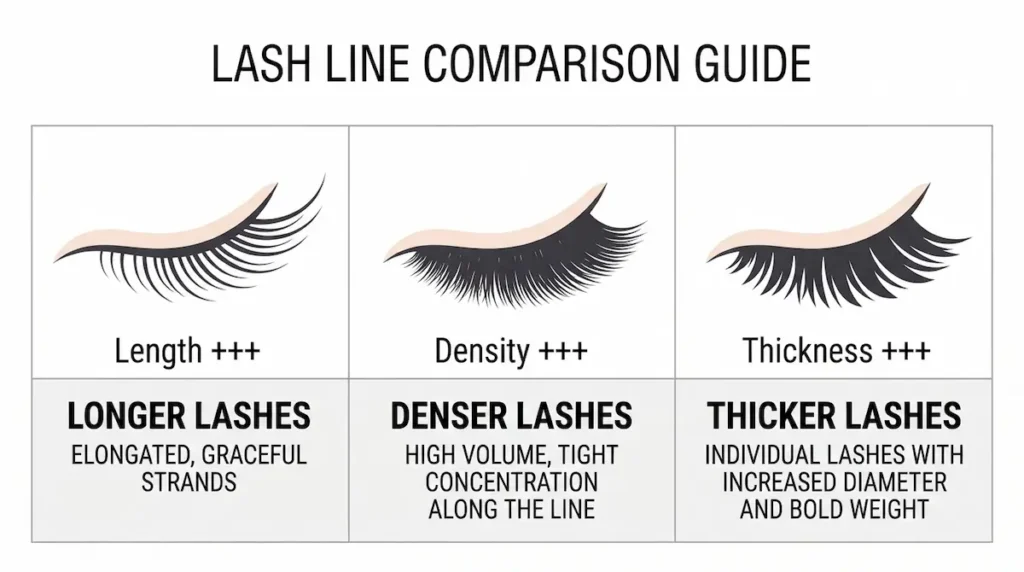
Almost every serum here promises “fuller” lashes. That word covers three different physical changes, and knowing which one you actually want saves you both money and disappointment.
- Length means each lash grows longer before it sheds. This comes from holding the lash in its active growth phase longer, and prostaglandin analogues do it best because they act on the follicle directly.
- Density means more lashes visible at once. Two things produce it: fewer lashes shedding at the same time, and fewer breaking off mid-length. Peptides and conditioning agents both contribute here, and this is where a cheaper formula can genuinely compete.
- Diameter means each individual lash is physically thicker. This is the weakest of the three on evidence. It’s measurable in a lab and difficult to see in a mirror, and most products claiming it are describing density instead.
The clearest evidence for all three separating comes from the only product that had to prove it. The FDA-approved label for Latisse states the drug treats inadequate lashes by increasing their growth “including length, thickness and darkness” — three outcomes, measured separately, because regulators required them to be. In the phase 3 programme behind that approval, the reported gains were roughly 25% in length, 106% in fullness and 18% in darkness against placebo. Nothing sold as a cosmetic has produced an equivalent record.
| Formula class | Targets | What the label’s actives can plausibly do | What it won’t do |
|---|---|---|---|
| Prostaglandin analogue (GrandeLASH-MD, RapidLash, NeuLash, Babe Original, Latisse) | Length first | Extend the growth phase, so lashes reach greater length before shedding; darkness follows from the same melanin pathway | Nothing about diameter is separately demonstrated in cosmetic formulas |
| Peptide complex (The Ordinary, and peptide-led formulas generally) | Density | Signal at the follicle and support the lash shaft, so fewer lashes break and more are visible at once | Match analogue length gains — no published head-to-head trial shows this |
| Botanical phyto-active (LashFood, Vegamour) | Density | Condition and support the lash line; Vegamour publishes a 60-day study of 30 participants for its fullness claim | Demonstrate a measured length increase; the published work is fullness-oriented |
| Conditioning oils and humectants (castor oil formulas) | Apparent fullness | Reduce breakage, add flexibility and shine | Change the growth cycle at all |
When a product claims all three at once, check whether it publishes a method. Several here report percentage improvements in length, fullness and health simultaneously with no sample size, duration or measurement technique attached. A figure without a method is a marketing statement, and it should be read as one.
The Prostaglandin Question, Weighed Honestly
This is the single decision that matters most in this category, and almost nobody covers it fairly. Brands defend the ingredient. Review sites condemn it. Both positions skip the parts that don’t suit them. Here is the whole picture.
Where these ingredients came from
Prostaglandin analogues were developed to lower pressure inside the eye in glaucoma patients. Clinicians treating those patients noticed something they hadn’t been aiming for: the lashes grew longer, thicker and darker. Allergan pursued that side effect deliberately, and in 2008 the FDA approved bimatoprost as Latisse. The cosmetics industry then adopted close chemical relatives of the same molecule, sold without prescription, without approval, and without the trial data.
That is the entire history, and it explains the tension that follows. The mechanism is real. The oversight isn’t.
The four names to look for on a label
| Ingredient | What it is | Appears on labels of | Regulatory position |
|---|---|---|---|
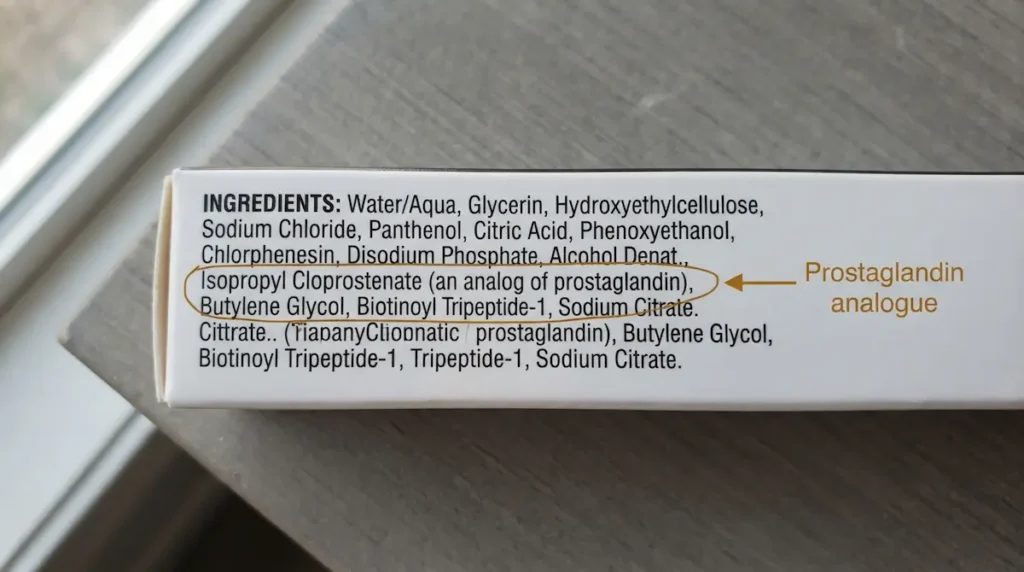
| Isopropyl cloprostenate (IPCP) — CAS 157283-66-4 | Prostaglandin F2-alpha analogue | GrandeLASH-MD, RapidLash, NeuLash | On Health Canada’s Cosmetic Ingredient Hotlist. Assessed at 0.005% in SCCS/1680/25 and not found safe |
| Bimatoprost | Prescription drug substance | Latisse, Lumigan | FDA-approved. The only lash growth product with approval |
| Dechloro dihydroxy difluoro ethylcloprostenolamide (DDDE, also listed as ethyl tafluprostamide) — CAS 1185851-52-8 | Analogue derived from tafluprost | RevitaLash Advanced | Assessed at roughly 0.018% in SCCS/1680/25 and not found safe |
| Methylamido-dihydro-noralfaprostal (MDN) — CAS 155206-01-2 | Analogue | NutraLuxe Lash MD, per its last published ingredient list | Assessed at 0.03% in SCCS/1680/25 and not found safe |
Three more appear in current formulas: cloprostenol isopropyl ester (Babe Original Essential), norbimatoprost (M2 Beaute) and dehydrolatanoprost (Obagi Nu-Cil).
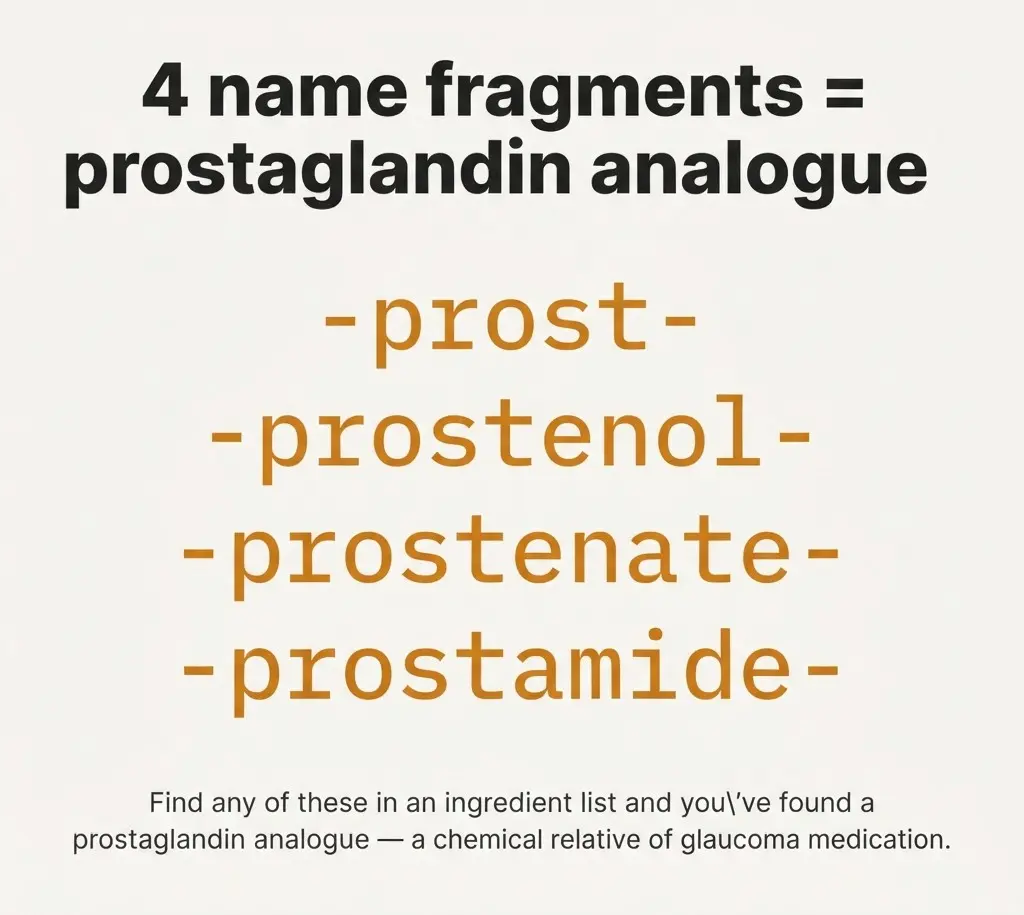
The rule that survives every reformulation: any ingredient name containing prost, prostenol, prostenate or prostamide belongs to this family. Brands introduce new names faster than any list can track. The name fragment doesn’t change.
What the documented risks actually are
These come from the FDA-approved label for bimatoprost and the published ophthalmology literature, not from anyone’s opinion:
- Iris pigmentation change. The Latisse label states plainly that increased brown iris pigmentation may occur and is likely to be permanent. Brown pigment spreads outward from the pupil across the iris.
- Prostaglandin-associated periorbitopathy (PAP). Loss of fat around the eye socket, producing a deepened upper eyelid crease, a hollowed look, and in some cases the eye appearing to sit further back. Bimatoprost is documented as causing this more often than latanoprost, tafluprost or unoprostone.
- Eyelid skin darkening. Reported as reversible in most patients after stopping.
- Conjunctival hyperemia and eye itching. The most common reactions in trials, at roughly 3–4%.
- Macular oedema, warranting caution in anyone with existing risk factors.
- Interference with glaucoma treatment. The label is explicit: anyone already using a prostaglandin analogue to control eye pressure should only add a lash product after consulting their physician, with pressure monitored.
One point of proportion, because it matters. Most of this evidence comes from bimatoprost delivered as a glaucoma eye drop — a higher dose, into the eye, daily, for years. A cosmetic serum brushed along the lash line is a different exposure. That doesn’t dismiss the risk, but anyone presenting glaucoma-drop outcomes as the expected result of a lash serum is overstating it.
What the EU concluded in February 2026
This is the most recent regulatory development in the category, and most sites still haven’t covered it.
The European Commission’s Scientific Committee on Consumer Safety adopted its final opinion, SCCS/1680/25, on 2 February 2026, publishing it on 10 February. The committee concluded that isopropyl cloprostenate, DDDE and MDN cannot be considered safe for use in cosmetics intended to promote eyelash and eyebrow growth.
The reasoning is more informative than the verdict:
- These compounds are pharmacologically potent even at the very low concentrations proposed — 0.005% for IPCP, 0.018% for DDDE, 0.03% for MDN.
- The submitted data was insufficient to rule out reproductive and developmental toxicity. The committee noted specifically that the people using these products are largely women of childbearing age.
- No genotoxic potential was identified, but the committee stated that carcinogenic risk could not be excluded because the relevant long-term studies had not been done.
- The SCCS could not identify any lower concentration it would consider safe.
This is an opinion, not a ban. Regulation (EC) No 1223/2009 has not been amended, prostaglandin analogues are not currently restricted under it, and products containing them remain legally on sale across the EU. A scientific opinion of this kind often precedes a restriction, but it is not one, and any site telling you these ingredients are now banned in Europe is wrong.
The sequence is worth knowing. The SCCS first examined DDDE and IPCP in Opinion SCCS/1635/21 and found it could not conclude they were safe at the concentrations proposed. Industry submitted further data by January 2024. The Commission asked for a fresh review. A preliminary opinion came in June 2025 with a public comment window to August. The February 2026 opinion is the final result of that process — a re-examination with more evidence in hand, reaching the same conclusion.

What the manufacturers say back — and whether it holds up
Grande Cosmetics has published a direct response, and it deserves a fair hearing rather than a dismissal.
Their position: isopropyl cloprostenate is not a hormone; it is classified by INCI as a hair conditioning agent; and GrandeLASH-MD does not cause iris colour change or orbital fat loss, substantiated by an eight-month third-party clinical study following 120 users. They also note, correctly, that few cosmetic brands fund studies at all.
Taking each in turn.
- On “not a hormone” — technically correct, and it settles less than it appears to. Prostaglandins aren’t hormones in the endocrine sense; they’re lipid signalling molecules that act locally rather than travelling through the bloodstream from a gland. But local signalling is precisely the mechanism of concern here, since the tissue being signalled is the one the product sits on.
- On INCI classification — this describes function, not safety. INCI is a naming dictionary. Listing an ingredient as hair conditioning says what it’s for, not that it has been assessed as safe for use beside the eye. The SCCS reviewed the same substance and reached a different conclusion about the same question.
- On the study — the claim is specific, and the supporting detail isn’t published. As presented, there is no journal, no DOI, no named research organisation, no protocol and no description of a control arm. To settle the iris question, a study would need a control group, standardised iris photography under fixed lighting, enough light-eyed participants to detect an effect that concentrates in that group, and follow-up beyond eight months — the FDA label notes iris changes may take months to years to become noticeable.
And the tension a reader deserves to see: the SCCS reviewed industry-submitted data through 2025 and 2026 and still found it insufficient. That does not prove Grande’s study is wrong. It does mean the regulator with access to the full dossiers wasn’t persuaded by what industry provided.
Our verdict: the study is a genuine signal that a brushed-on cosmetic dose likely carries lower risk than a daily glaucoma drop. It is not enough to call the risk absent, and it should not be read that way.
The same standard applies elsewhere. UKLASH advertises 85% longer, 80% fuller and 88% healthier lashes with no sample size, duration or measurement method published anywhere on the page. The wording — “longer-looking” — points to participants rating their own lashes rather than anyone measuring them. That is a perception survey, and it should be labelled as one.
What prostaglandin-free formulas use instead
Peptide complexes signal at the follicle: Myristoyl Pentapeptide-17, Biotinoyl Tripeptide-1, Oligopeptide-2, and Acetyl Tetrapeptide-3 paired with red clover. Panthenol and biotin work on the lash shaft itself. Botanical actives — mung bean, red clover, pumpkin seed, ginseng, curcumin, Centella asiatica, green tea — sit behind most “clean” formulas.
The honest trade-off: published timelines for these formulas run longer, most of the ingredient-level evidence is manufacturer-generated and often laboratory rather than human, and no controlled head-to-head trial has compared a peptide formula against an analogue. They are gentler. The evidence that they match analogue results does not exist.
Eye Colour Changes the Answer
If you have blue, green, grey or hazel eyes, your decision here is different from someone with brown eyes, and no product page will tell you that.
The mechanism is pigment. Prostaglandin analogues increase the melanin content of existing cells in the iris — the FDA label is specific that this is more pigment in the same cells, not more cells. Brown pigment then spreads outward from the pupil across the iris. Where there is little pigment to begin with, any increase shows. Where the iris is already dark brown, the same change is far harder to see.
The Latisse label states that increased brown iris pigmentation is likely to be permanent, and that the change may take months or even years to become noticeable.
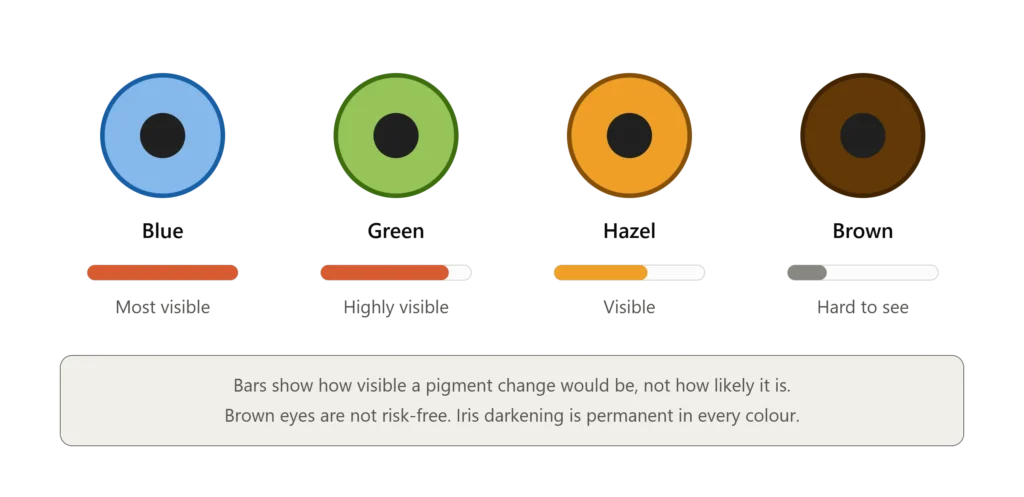
One honest qualification before the decision block. The permanent-pigmentation warning is built on bimatoprost delivered as a glaucoma eye drop. With drop dosing, iris pigmentation was reported in about 1.5% of patients after 12 months, and did not rise further over three years. Applied along the lash line, absorption into the eye is far lower, and iris colour change has not been definitively demonstrated in the lash trials. The warning stands on the label because the risk cannot be excluded, not because it has been shown to happen at cosmetic doses.
That distinction changes what a sensible decision looks like.
- If your eyes are blue, green, grey or hazel. Use a prostaglandin-free formula. The change is permanent if it happens, it would be most visible on you, and nothing about longer lashes is worth an outcome you cannot undo. If you decide otherwise, photograph both irises in daylight before you start and again every three months.
- If your eyes are dark brown. Your iris risk is lower and any change would be much harder to perceive. Everything else on the list still applies to you — fat loss around the eye, eyelid darkening, and interference with glaucoma treatment are not eye-colour dependent.
- If you have heterochromia or one iris lighter than the other. Apply the caution that fits the lighter eye. Pigment change on one side of an already asymmetric pair is the outcome hardest to live with, and the one most difficult to correct.
- If you’re already using one and now worried. Photograph both irises in good natural light today, so you have a baseline. Look for brown appearing around the pupil and spreading outward, a deepening crease in your upper eyelid, and darkening of the skin along your lash line. If you see any of them, stop and book an eye examination. Bring the product with you.
What reverses and what doesn’t
| Effect | Reverses? | Timeframe | Source |
|---|---|---|---|
| Eye redness, itching, irritation | Yes | Days after stopping | Latisse FDA label, adverse reactions |
| Eyelid skin darkening | Usually | Weeks to months | Latisse FDA label — reversible in most patients |
| Fat loss around the eye socket (PAP) | Often, partially | Months, and not always completely | Published ophthalmology case literature |
| Lash length gained | Reverses | Lashes return to baseline after stopping | Latisse FDA label |
| Iris colour change | No | Permanent | Latisse FDA label — likely to be permanent |
Read that bottom row before anything else on this page. Four of the five effects here undo themselves. One does not, and it is the only one that changes something people can see when they look at you.
Every Serum, Label by Label
Ranked by our published rubric, which weights label transparency and ingredient profile at 50% combined. That means effective products score low when their label carries an analogue. It’s a stated value, not a hidden one.
The Ordinary Multi-Peptide Lash & Brow
Green9.1Label checked 5 Aug 2026: aqua, glycerin, butylene glycol, then four peptide complexes — Myristoyl Pentapeptide-17, Biotinoyl Tripeptide-1, Oligopeptide-2, Acetyl Tetrapeptide-3. No analogue. No fragrance, no denatured alcohol.
Brand states plainly it contains no prostaglandins. Its 30-subject study is published as 4 weeks on one retailer and 12 weeks on Ulta — same study, two durations.
Vegamour GRO
Green8.4Checked 5 Aug 2026: water, pentylene glycol, propanediol, magnolia bark, red clover and mung bean sprout extract, Acetyl Tetrapeptide-3. No analogue.
Publishes both numbers: 60-day study, 30 participants, twice daily. Rare in this category.
LashFood Phyto-Medic
Green8.2Checked 5 Aug 2026: botanical waters, arginine, hydrolysed soy and rice proteins, adenosine. No peptide INCI name, no biotin, no analogue. Alcohol-free and fragrance-free per label.
Ecocert certified at 99.49% natural origin — a natural-content audit, not a safety or clinical one.
Note the brand’s own pages list fill weight as both 2mL and 3mL.
Terez & Honor
Green7.9Checked 5 Aug 2026: Capixyl and hydrolysed silk, no analogue listed.
Went viral on TikTok. We could not locate a published sample size or duration behind its results claims.
Every product below lists a prostaglandin analogue on its label. Why that matters →
GrandeLASH-MD
Amber7.4Checked 5 Aug 2026: isopropyl cloprostenate listed mid-label, with radish root ferment, sodium hyaluronate, grape seed extract and amino acids. Grande labels it openly as “an analog of prostaglandin” and carries a use warning at Ulta.
Claims an 8-month third-party study of 120 users. No journal, DOI, protocol or control arm published.
Babe Original Essential
Amber7.0Checked 5 Aug 2026: cloprostenol isopropyl ester — same chemical family, different name — with biotin, castor oil and amino acids.
No sample size or duration published for its results claims.
RapidLash
Amber6.9Checked 5 Aug 2026: isopropyl cloprostenate, listed after alcohol, alongside Octapeptide-2, Copper Tripeptide-1, biotin and pumpkin seed extract.
No published method for its 60-day results claim.
NeuLash
Amber6.4Checked 5 Aug 2026: an ingredient list identical to RapidLash’s — all 31 ingredients, same order, including isopropyl cloprostenate. NeuLash’s own directions on its product page instruct you to “apply RapidLash.” Both trace to Skin Research Laboratories.
Its warning block is the most thorough here, naming iris discolouration and orbital fat loss outright. Its claim publishes 102 subjects over 8 weeks at an independent facility — self-reported, but disclosed.
Latisse (bimatoprost 0.03%)
Amber6.2The only lash product the FDA has approved. Its label states iris pigmentation may occur and is likely permanent, and that it may interfere with glaucoma pressure control.
It scores low here because our rubric weights analogue presence heavily — not because the evidence is weak. On evidence alone it ranks first.
ForChics ForLash, Nulastin and UKLash were checked in the same pass. Their full breakdowns are being written.
Every serum compared
| Product | Price | Price/mL | Analogue | Key active | Method published | Score |
|---|---|---|---|---|---|---|
| The Ordinary | ~$20 | ~$4 | None | 4 peptides | Partial | 9.1 |
| Vegamour GRO | 3mL | — | None | Red clover, mung bean | Yes | 8.4 |
| LashFood | $78 | $26 | None | Botanical complex | No | 8.2 |
| Terez & Honor | ~$25 | ~$8 | None | Capixyl | No | 7.9 |
| GrandeLASH-MD | $65 | $33 | IPCP | Isopropyl cloprostenate | Partial | 7.4 |
| Babe Original | $49 | — | CIE | Cloprostenol isopropyl ester | No | 7.0 |
| RapidLash | ~$40 | ~$13 | IPCP | Isopropyl cloprostenate | No | 6.9 |
| NeuLash | $95 | — | IPCP | Isopropyl cloprostenate | Partial | 6.4 |
| Latisse | ~$130/mo | — | Bimatoprost | Bimatoprost 0.03% | Yes | 6.2 |
“Clinically Proven” — What Each Brand’s Evidence Actually Is
A results claim is checkable when it publishes five things: sample size, duration, whether there was a control arm, whether anyone measured or participants rated themselves, and where the study can be read. We applied the same five to every product.
- Where claims hold up. Latisse publishes all five: a 278-participant, 16-week trial with standardised photography, reviewed by the FDA. Vegamour publishes sample size and duration. NeuLash publishes both plus the testing setting, which is more than most.
- Where we could not locate a method. LashFood, Terez & Honor, RapidLash and Babe Original describe outcomes without publishing a sample size or duration anywhere we could find. Grande names a study but not its protocol. UKLASH advertises 85% longer, 80% fuller and 88% healthier with no method attached, and “longer-looking” points to self-rating rather than measurement.
- What this doesn’t prove. A product without a published study isn’t thereby ineffective. It’s unverified. Those are different things, and treating them as the same would be the exact sloppiness this page exists to correct.
The Right Serum for Your Situation
- Sensitive or reactive eyes. This is a different avoid-list from prostaglandin-free. Watch for denatured alcohol high in the ingredients, added fragrance, and formaldehyde releasers — DMDM hydantoin, quaternium-15, imidazolidinyl urea, diazolidinyl urea, bronopol. Cetyl, stearyl and cetearyl alcohol are emollients and cause no trouble. No formula can promise your eye won’t react.
- Natural or clean. These aren’t the same as prostaglandin-free. Ecocert audits every ingredient; “clean” is a word anyone can print. LashFood holds the certification.
- On a budget. Drugstore means physically on the shelf — RapidLash. Cheap means under $30 anywhere — The Ordinary, which at roughly $4/mL is the cheapest here by a distance. Do the per-mL maths: a $49 serum in a 1mL tube costs more per month than a $65 one in 2mL.
- Lashes and brows together. The Ordinary is formulated and sold for both. Brow skin tolerates more than the lash line, so a lash-safe formula is automatically brow-safe — never the reverse.
- Buying at Sephora or Ulta. The Ordinary and GrandeLASH-MD are both stocked at Ulta as of 16 August 2026. Authorised retail buys you two things worth having: a returns route, and certainty the tube is genuine.
- Fastest visible change. That points to the analogue formulas, and we won’t pretend otherwise. Read the trade-offs first.
What Dermatologists and Eye Doctors Actually Recommend
Dermatologists assess how skin tolerates a product. Ophthalmologists and oculoplastic surgeons assess the eye itself. For something applied millimetres from the cornea, you want the second opinion as much as the first.
The clearest answer to what clinicians recommend is the regulatory one: Latisse (bimatoprost 0.03%) is the only lash growth product approved by the FDA. Over-the-counter serums are regulated as cosmetics, which means no pre-market approval and no required efficacy evidence. That gap is why analogues appear in cosmetics without the scrutiny applied to the prescription version.
Clinical opinion genuinely divides here. Some prescribers are comfortable with supervised analogue use, monitoring iris colour and eyelid contour at intervals. Others avoid the class in cosmetic settings entirely, citing the SCCS position and the permanence of pigment change. Both views are held by qualified people.
Four things to bring to an appointment: your eye colour, any glaucoma or raised-pressure history, whether you wear contact lenses, and whether you’re pregnant or trying. Those four determine most of the advice you’ll get.
This is a label and research summary, not medical advice. Consult an eye care professional before starting any lash serum.
Availability by Country
- United Kingdom. Boots, Superdrug, Cult Beauty, Look Fantastic and Space NK carry most of this list in GBP. Post-Brexit the UK runs its own cosmetics regime under OPSS rather than following EU decisions automatically, so the February 2026 SCCS opinion does not apply here directly.
- Canada. Isopropyl cloprostenate appears on Health Canada’s Cosmetic Ingredient Hotlist, so serums listing it are not legitimately sold in Canada. That removes GrandeLASH-MD, RapidLash and NeuLash from the Canadian shelf. Ordering them across the border defeats the point of a label check.
- Australia. Adore Beauty, Mecca and Priceline stock most peptide formulas. The TGA draws the line at therapeutic claims — a product promising to treat a condition stops being a cosmetic.
- New Zealand. Medsafe applies similar reasoning. Local stock is thinner, and most buyers order from Australian retailers with a shipping delay.
How to Apply Lash Serum
- Start with clean, completely dry skin — oil-free cleanser only.
- One dip serves both eyes. Draw a single stroke along the upper lash line, like liquid eyeliner.
- Never the lower lash line or waterline.
- Let it dry fully before anything else touches your face.
- Night is better than morning.
- Contacts out first, back in after 15 minutes.
This matters more than it sounds. Safety assessments for these products assume application above the lash line, once daily, without double-dipping. Use it differently and you’re outside the pattern it was assessed under.
The mistakes that cause most problems: double-dipping and over-applying, which raises sensitivity without improving results; applying to the lower lid, where blinking spreads it anyway; applying to damp skin, which carries product into the eye; applying to the lid rather than the lash line, which is what drives eyelid darkening; switching products before 12 weeks; and quitting at week four, which is simply too early to judge.
What Happens If You Stop
Lashes return to baseline over one to two growth cycles — roughly four to eight weeks. The Latisse label states this directly: eyelash growth is expected to return to pre-treatment levels after discontinuation. It applies to every formula here, because they extend the growth phase rather than changing the follicle permanently.
Which makes this an ongoing cost, and almost nobody publishes the arithmetic.
| Product | Year 1 (daily) | Maintenance year | 3-year total |
|---|---|---|---|
| The Ordinary | ~$84 | ~$50 | ~$184 |
| GrandeLASH-MD | ~$264 | ~$160 | ~$584 |
| LashFood | ~$468 | ~$280 | ~$1,028 |
| Latisse | ~$1,560 | ~$940 | ~$3,440 |
Maintenance assumes every other day after the first 12 weeks, which is what most brands advise.
How We Check Labels and Score
- What we do. We read each brand’s currently published ingredient list at source, record the date, and screen it against 12 prostaglandin analogue names. We calculate price per millilitre and cost per month from current retail pricing. We check every results claim against five published-method criteria. Labels are re-checked every 90 days.
- What we do not do. We run no clinical trials. We have no testing panel. We employ no medical reviewer. Anyone telling you otherwise about their own site should be asked for the protocol.
- The six criteria: Label Transparency 25% · Ingredient Profile 25% · Value per mL 20% · Published Evidence Quality 15% · Regulatory Status 10% · Ease of Use 5%. Published here, unchanged since launch.
- What this can’t tell you. Whether a product works for you. How two products compare head to head. Whether an ingredient is safe at the concentration used. A label check tells you what’s in the bottle — not what the bottle will do.
Found an error? Contact us via the contact page, and we’ll correct it within 48 hours, with the change noted.
Frequently Asked Questions
Do lash serums actually work?
Some do. Prostaglandin analogues reliably extend the lash growth phase and produce measurable length — that’s established in the bimatoprost trials. Peptide formulas act more gently, mainly on density and breakage, and their published evidence is thinner. Conditioning oils don’t affect growth at all.
Which is better, peptide or prostaglandin?
Analogues work faster and carry documented ocular risks. Peptides take longer, do less, and carry far less risk. If you have light-coloured eyes, are pregnant, or are treated for glaucoma, that choice is already made for you.
Can a lash serum change my eye colour?
Prostaglandin analogues can increase brown iris pigment, and the Latisse label states this is likely permanent. It’s most visible in blue, green and hazel eyes. The evidence comes mainly from glaucoma drop dosing; at cosmetic doses it hasn’t been definitively demonstrated, but it can’t be excluded.
Are lash serums FDA-regulated?
Over-the-counter serums are cosmetics, which means no approval is required before sale and no efficacy evidence is required at all. Only Latisse holds FDA approval, as a prescription drug.
What did the EU decide about lash serums in 2026?
In Opinion SCCS/1680/25, adopted 2 February 2026, the Scientific Committee on Consumer Safety concluded three analogues — IPCP, DDDE and MDN — cannot be considered safe in lash growth cosmetics. It’s a scientific opinion, not a ban. EU law is unchanged.
Why is the cheap one not actually cheaper?
Because tube sizes vary by a factor of five. A $49 serum in a 1mL tube runs out in six weeks; a $65 serum in 2mL lasts three months. Compare cost per month, not sticker price.
Can I use one while pregnant or breastfeeding?
Not a prostaglandin formula. The SCCS could not exclude reproductive and developmental toxicity, and noted the user base is largely women of childbearing age. Raise even a peptide formula with your OB-GYN first.