Lash Serums Without Prostaglandin: 5 Labels That Actually Pass (2026)
Five serums passed our label check on 5 August 2026: The Ordinary Multi-Peptide, Vegamour GRO, LashFood Phyto-Medic, Terez & Honor, and ForChics ForLash. None lists a prostaglandin analogue. One product we expected to join them — Nulastin — failed, and its own packaging warning is the reason. Formulas change without notice, so check before you buy.
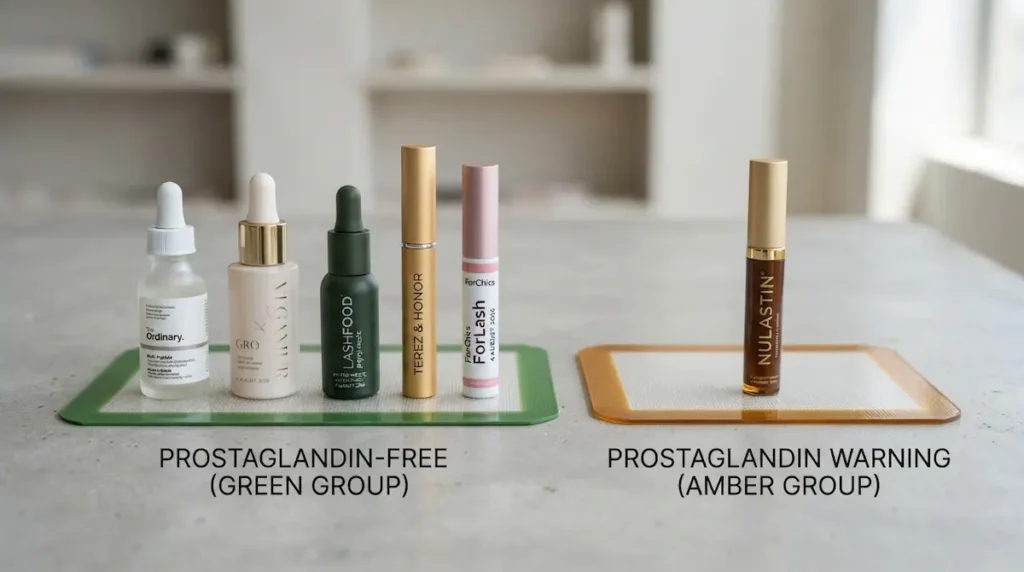
The five that passed
The Ordinary Multi-Peptide Lash & Brow — ~$20 / 5mL · ~$4/mL
Checked 5 Aug 2026. Four peptide complexes: Myristoyl Pentapeptide-17, Biotinoyl Tripeptide-1, Oligopeptide-2 and Acetyl Tetrapeptide-3, with caffeine and panthenol. The brand states directly on its site that the formula contains no prostaglandins. No fragrance, no denatured alcohol.
Suits anyone testing the category without committing money to it.
Vegamour GRO Lash Serum — 3mL, roughly two months
Checked 5 Aug 2026. Magnolia bark, red clover sprout and mung bean sprout extract, with Acetyl Tetrapeptide-3. Marketed as hormone-free, and the label supports it.
Suits buyers who want botanicals with a stated study behind the claim.
LashFood Phyto-Medic — $78 / 3mL · $26/mL
Checked 5 Aug 2026. Botanical waters, arginine, hydrolysed soy and rice proteins, adenosine. No peptide INCI name, no biotin, no analogue. Alcohol-free and fragrance-free.
Suits reactive eyes and anyone avoiding alcohol near the lash line.
ForChics ForLash — $39 / 3mL · $13/mL
Checked 5 Aug 2026. Peptides with Panax ginseng, rosemary, magnolia bark and biotin. No analogue on any published version of the list.
One caveat worth knowing: ForChics publishes different peptide names in different places. Its own safety page lists Myristoyl Pentapeptide-4; an ingredient database records Myristoyl Pentapeptide-17 and Biotinoyl Tripeptide-4; a third source names Biotinoyl Tripeptide-1. All are peptides, none is an analogue, but the inconsistency is real and worth noting before you rely on a specific active.
Terez & Honor — ~$25 / 3mL
Checked 5 Aug 2026. Capixyl and hydrolysed silk. No analogue.
Suits a low-cost first try.
The one we expected to pass
Nulastin LASH Follicle Fortifying Serum — 3mL
Nulastin sells on elastin. Elastaplex Technology, biodesigned proteins, five US patents, a founder who synthesised the first elastin protein of its kind. Nothing in that pitch mentions prostaglandins.
Its ingredient list reads: water, Myristoyl Pentapeptide-17, glycerin, sh-Polypeptide-50 (elastin), keratin, carbomer, sodium phytate, sodium phosphate, sodium chloride, sh-Polypeptide-62, isopropyl cloprostenate, sodium hydroxide, phenoxyethanol.
The brand is not hiding it. Its own product page carries the warning: this cosmetic contains a small amount of isopropyl cloprostenate, an analog of prostaglandin. Credit where it’s due — that’s more disclosure than several competitors manage.
But two things follow. The analogue sits among the actives, not in trace territory. And a shopper reading Nulastin’s marketing — elastin, keratin, signal peptides, patents — would have no reason to look for it. On Dermstore, the product is listed with a full clean-claims block (no silicones, sulfates, parabens, MI/MCI, formaldehydes, phthalates, talc) and no mention of the analogue anywhere in it.
Also worth logging: Amazon lists the same ingredient as (+)-Cloprostenol Isopropyl Ester. Different name, same substance. That’s not an error on anyone’s part — it’s how this class works.
The four that never claimed otherwise
| Product | Analogue listed | Position on the label |
|---|---|---|
| GrandeLASH-MD | Isopropyl cloprostenate | Mid-list, labelled by the brand as “an analog of prostaglandin” |
| RapidLash | Isopropyl cloprostenate | Immediately after alcohol, near the preservatives |
| NeuLash | Isopropyl cloprostenate | Same position — the two lists are identical |
| Babe Original Essential | Cloprostenol isopropyl ester | Among the actives |
Grande labels the ingredient explicitly and carries a use warning at retail. NeuLash publishes the most thorough warning block of any brand here. Neither is concealing anything. They’re simply not the answer if you’re on this page.
“Prostaglandin-free” on the box, and what the label says
Nobody regulates the phrase “prostaglandin-free.” No agency defines it, audits it, or penalises its misuse. A brand can print it because its formula avoids bimatoprost specifically, while listing a cosmetic analogue under a name almost no shopper recognises.
Three things make this hard to catch.
- The names don’t look related. Isopropyl cloprostenate, cloprostenol isopropyl ester, dechloro dihydroxy difluoro ethylcloprostenolamide, methylamido-dihydro-noralfaprostal. Nothing in those words says “prostaglandin” to a normal reader.
- One substance carries several names. Nulastin’s own site says isopropyl cloprostenate; Amazon says (+)-cloprostenol isopropyl ester. Both are correct. Neither matches the other on a search.
- The marketing sits in a different place from the ingredients. Clean-claim lists — no parabens, no sulfates, no phthalates — are true and complete on their own terms while saying nothing about the analogue three lines down the INCI.
The habit that solves it: read the ingredient list before the front of the box, every time, including on repurchase. Every analogue name currently in use →
What the EU concluded in February 2026
On 2 February 2026 the EU’s Scientific Committee on Consumer Safety adopted Opinion SCCS/1680/25, concluding that three analogues — isopropyl cloprostenate, DDDE and MDN — cannot be considered safe in cosmetics intended to promote lash and brow growth. The committee could not identify any concentration it would call safe, including the very low ones proposed.
It is not a ban. Regulation (EC) No 1223/2009 is unchanged. These products remain legally on sale across the EU, and anyone telling you otherwise is wrong.
What it changes for a buyer is narrower than it sounds: it removes the argument that low concentration settles the question. The committee looked at 0.005% for isopropyl cloprostenate and still declined to clear it. If you were weighing “it’s only a trace amount,” that reasoning is now weaker than it was.
Natural, clean, prostaglandin-free — three different claims
These get used as though they mean the same thing. They don’t, and the difference matters when you’re choosing.
- Prostaglandin-free describes a chemical class. It’s binary and checkable: read the list, look for the class, done. A formula can be prostaglandin-free and still contain denatured alcohol and fragrance.
- Natural describes sourcing. It says where an ingredient came from, not what it does to your eye. Ecocert is the one meaningful version here — LashFood holds certification at 99.49% natural origin, which is an audited figure, not a slogan. Note carefully what that certifies: natural content, not clinical efficacy and not ocular safety.
- Clean describes nothing enforceable. Any brand can print it. Nulastin’s clean-claim list is entirely accurate and sits on a product containing an analogue.
The botanicals doing the actual work in this category are red clover, mung bean sprout, Panax ginseng, magnolia bark, saw palmetto and Polygonum. Red clover has the strongest published backing, mostly through Capixyl, where the manufacturer reported an increased growth-to-rest phase ratio over four months. That work comes from the ingredient supplier, not an independent group. The rest sit on thinner ground — plausible mechanism, limited finished-formula evidence.
Do peptide serums actually work?
Honestly: they do something, the something is smaller than analogues deliver, and the evidence is patchier than any brand implies.
- What’s supported. Myristoyl Pentapeptide-17 stimulates keratin gene expression — that’s laboratory work with a clear mechanism, and it’s why the same peptide appears in most formulas on the passing list. Biotinoyl Tripeptide-1 has a manufacturer study behind it: 30 volunteers using a mascara containing the diluted trade version, with lashes reported 17% longer and 19% thicker after 30 days.
- What’s missing. Most published work is on single ingredients in isolation, funded by the companies selling them. Finished formulas contain a dozen actives at undisclosed concentrations, and no study can attribute an outcome to any one of them. Independent replication is rare.
- And the gap nobody publishes. There is no controlled head-to-head trial comparing a peptide serum against a prostaglandin analogue. Every comparison you’ll read — including the ranking on our own homepage — is inference from separate studies with different designs, participants and measures. That’s a reasonable basis for a decision. It is not the same as evidence.
The practical reading: peptide formulas mainly reduce breakage and shedding, which shows up as density. Length gains are more modest, and take longer to appear. If you want the change to be obvious to other people in a month, this class won’t do it. If you want gradual improvement without the risks the SCCS flagged, it will.
FAQs
Which lash serums have no prostaglandin?
On labels checked 5 August 2026: The Ordinary Multi-Peptide, Vegamour GRO, LashFood Phyto-Medic, ForChics ForLash and Terez & Honor. Verify before purchase — brands reformulate without announcing it.
How do I know if my lash serum has prostaglandin?
Read the ingredient list, not the front of the box, and look for any name containing prost, prostenol, prostenate or prostamide. If you find one, that’s the class. Marketing language on the packaging tells you nothing reliable.
Is Nulastin prostaglandin-free?
No. Nulastin’s own product page states the cosmetic contains a small amount of isopropyl cloprostenate, an analog of prostaglandin, and the ingredient appears on the label between sh-Polypeptide-62 and sodium hydroxide.
Do prostaglandin-free serums actually work?
They reduce breakage and shedding, which makes lashes look denser. Published length gains are smaller than analogues produce and take longer to appear. No controlled trial has compared the two classes directly.
Is “natural” the same as prostaglandin-free?
No. Natural describes where ingredients came from; prostaglandin-free describes a chemical class. A product can be marketed as clean and natural while listing an analogue.
Why is isopropyl cloprostenate restricted in Canada?
It appears on Health Canada’s Cosmetic Ingredient Hotlist, which lists substances restricted or prohibited in cosmetics sold there. That removes several of the biggest global sellers from legitimate Canadian retail.
This is a label and research summary, not medical advice. Consult an eye care professional before starting any lash serum.