Lash Serum Side Effects: Every Documented Risk & Source
Almost every serious side effect in this category traces to one ingredient class: prostaglandin analogues. The mild ones — stinging, redness, a stye — can come from any formula, and usually come from a preservative or a botanical rather than the active.
This page separates the two. Every effect below is documented in the FDA-approved label for bimatoprost or in published ophthalmology literature. Nothing here is our observation.
Iris pigmentation change
Reverses: No. Permanent.
The FDA label for Latisse states that increased brown iris pigmentation may occur and is likely to be permanent. Brown pigment appears around the pupil and spreads outward in a circle.
The mechanism matters. Pigment increases inside existing melanocytes — more melanin in the same cells, not more cells. That’s why it doesn’t fade: nothing is added that the body clears away.
It shows most in blue, green, grey and hazel eyes because there’s little pigment there to begin with. In dark brown eyes the same change happens and is far harder to see.
The label also notes the change may take months to years to become noticeable, so an early check tells you nothing.
What the numbers say. With bimatoprost as a glaucoma drop, iris pigmentation was reported in about 1.5% of patients at 12 months and did not rise further over three years. That’s a higher dose, into the eye, for years. A cosmetic serum brushed along the lash line delivers far less, and iris change has not been definitively demonstrated at cosmetic doses. The warning stands because the risk cannot be ruled out.
Which serums carry the ingredient → the full analogue list
Prostaglandin-associated periorbitopathy (PAP)
Reverses: Often, partially. Months.
This is the “sunken eye” effect people describe without knowing its clinical name. Peplinski and Smith first described it in 2004, in three patients using bimatoprost drops in one eye only — the treated eye changed and the other didn’t.
What it looks like:
- Deepening of the upper eyelid sulcus, the hollow above the eyelid
- Loss of fat around the orbit
- Relative enophthalmos — the eye appearing to sit further back
- Loss of fullness in the lower eyelid
- A higher, deeper eyelid crease
- Sometimes ptosis, sometimes upper eyelid retraction
Why it happens. Prostaglandin F2-alpha activation inhibits adipogenesis — it stops fat cells forming. Orbital fat atrophy follows, confirmed on MRI and histology. No inflammation is found in the tissue, which is part of why it reverses.
On reversibility. Nine patients who stopped treatment for cosmetic reasons showed partial reversal. A separate study switched patients from bimatoprost to latanoprost and found the sulcus deepening reversed in most. In a 2022 study switching 23 patients to an EP2 agonist, objective sulcus deepening improved by 76% at seven months, with 95% reporting subjective improvement.
Partial is the honest word. Most people recover much of it. Not everyone recovers all of it.
Bimatoprost produces this more often than latanoprost, travoprost or tafluprost. In one 86-patient study of unilateral users, a masked grading system found measurable differences between treated and untreated eyes — and notably, very few patients had noticed the change themselves.
Eyelid skin darkening
Reverses: Usually. Weeks to months.
Hyperpigmentation of the eyelid skin, and of the skin immediately around it. The Latisse label describes it as reversible in most patients after stopping.
This one is largely an application problem. Product on the eyelid rather than along the lash line is what drives it. Applying more than a single thin stroke, or letting the serum pool, puts it exactly where it causes this.
In the switching study above, eyelid and peri-eyelid pigmentation improved in 76% of patients.
Conjunctival hyperemia and eye itching
Reverses: Yes. Days.
Red, bloodshot whites and itching were the most common reactions in the bimatoprost trials, at roughly 3–4%. They settle within days of stopping.
Persistent redness that doesn’t settle is worth an eye examination rather than waiting it out.
Macular oedema
Reverses: Depends. Requires treatment.
Swelling of the macula, including cystoid macular oedema. The Latisse label advises caution in anyone with existing risk factors — aphakia, a torn posterior lens capsule, or a known predisposition.
Rare, and serious. Sudden blurring or distortion of central vision needs same-day attention.
Interference with glaucoma treatment
Reverses: Yes, but this is the one to take seriously.
If you already use a prostaglandin analogue to control intraocular pressure, adding a cosmetic one may interfere with that control. The Latisse label is explicit: consult your physician first, and have your pressure monitored.
This is the single most clinically important line on this page. It is rarely stated on product packaging, and the people it affects are already under a doctor’s care for a sight-threatening condition.
What peptide and botanical serums cause
The mild end, and it’s a genuinely different picture.
Stinging on application — usually the alcohol content, or product reaching the eye itself.
Contact dermatitis — itching, swelling, scaling around the eye. Eyelid skin is the thinnest on the body at about 0.55mm, with a highly hydrated outer layer, which makes it far more permeable than facial skin. Allergic contact dermatitis accounts for around 43% of eyelid dermatitis cases.
The trigger is rarely the peptide. Peptides are short amino acid chains the body handles routinely. The usual culprits are preservatives — methylisothiazolinone, formaldehyde releasers — fragrance, and botanical extracts. “Natural” is not the same as non-allergenic.
Temporary lash shedding at the start — some formulas push follicles into the growth phase, and older lashes shed first. Not damage.
Styes — usually from product blocking the meibomian glands along the lash line, which is another argument for one thin stroke rather than a heavy one.
None of these are permanent. No case of iris colour change or orbital fat atrophy has been documented from a peptide formula.
Which serums list no analogue → the pass list
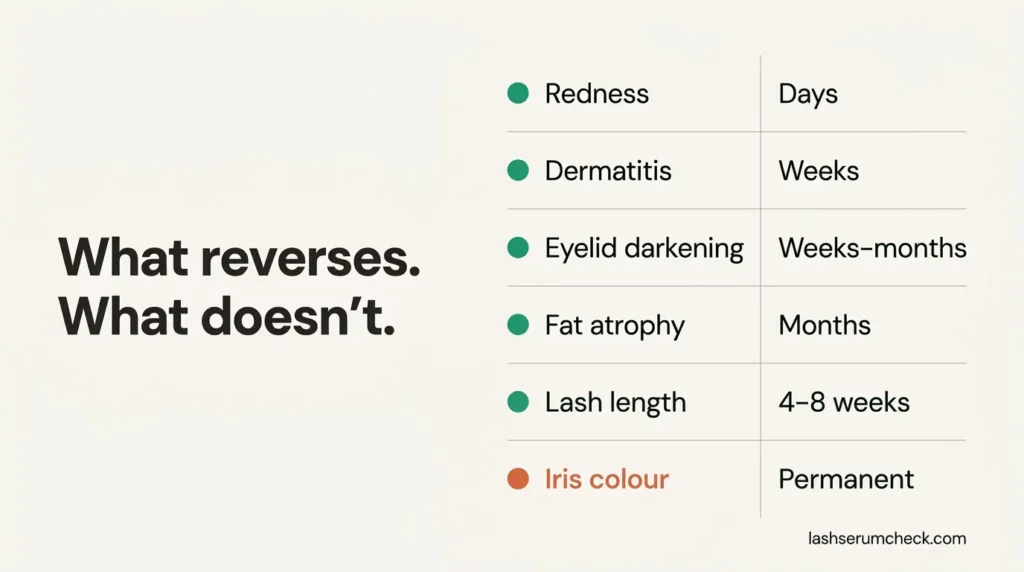
What reverses and what doesn’t
| Effect | Reverses | Timeframe |
|---|---|---|
| Conjunctival hyperemia, itching | Yes | Days |
| Contact dermatitis | Yes | Days to weeks after stopping |
| Eyelid skin darkening | Usually | Weeks to months |
| Periorbital fat atrophy (PAP) | Partially, in most | Months |
| Lash length gained | Yes — returns to baseline | 4–8 weeks |
| Iris pigmentation | No | Permanent |
Five of six undo themselves. One does not.
When to stop and see someone
Stop and book an eye examination if you notice brown appearing around your pupil, a deepening hollow above your eyelid, swelling or scaling that doesn’t settle within a few days, redness lasting more than a week, or any change to your vision.
Take the product with you. The ingredient list is the first thing a clinician will want.
If you’re already using a prostaglandin formula and you’re worried, photograph both irises today in natural daylight. Without a baseline, a slow change over months is almost impossible to judge — and comparing photographs is currently the only recommended way to assess it.
Before you buy anything → what the regulators have said, weighed honestly
This is a label and research summary, not medical advice. Consult an eye care professional before starting any lash serum.