The Ordinary Lash Serum: Does the $15 One Actually Work?
Most people buy this expecting longer lashes and judge it on whether they got them. That’s the wrong test, and The Ordinary’s own marketing quietly tells you so.
Read their product copy. Thicker. Fuller. Healthier-looking. Density. Volume. Overall appearance. Now look for the word lengthening. It isn’t there — not on their site, not on the carton, not on the Ulta listing.
That omission is deliberate, and it’s the most useful thing to know before you spend $15. This serum is built to reduce breakage and improve density. If you want lashes that reach further than they do now, it isn’t the product, and no amount of patience will make it one.
The five complexes in the tube
The Ordinary describes this as four peptide complexes. Their own ingredient breakdown names five trademarked technologies, each licensed from a different supplier:
| Complex | Owner | What’s in it |
|---|---|---|
| SYMPEPTIDE XLASH® | Symrise AG | Myristoyl Pentapeptide-17 |
| Widelash™ | Sederma | Biotinoyl Tripeptide-1, panthenol |
| Anargy® | LipoTrue | Oligopeptide-2, glycoproteins |
| CAPIXYL™ | Lucas Meyer | Acetyl Tetrapeptide-3, red clover flower extract |
| REDENSYL™ | Givaudan | Larch wood extract, green tea leaf extract, zinc chloride |
The count reconciles: REDENSYL isn’t a peptide complex. It’s a botanical and zinc system originally developed for scalp hair. Four peptide complexes plus one that isn’t. Add high-solubility caffeine and you have the actives.
Full list, checked at theordinary.com on 5 August 2026: aqua, glycerin, butylene glycol, Myristoyl Pentapeptide-17, Biotinoyl Tripeptide-1, Oligopeptide-2, Acetyl Tetrapeptide-3, caffeine, panthenol, arginine, glycine, glycoproteins, Larix europaea wood extract, Camellia sinensis leaf extract, Trifolium pratense flower extract, dextran, maltodextrin, zinc chloride, hydroxyethylcellulose, xanthan gum, trisodium ethylenediamine disuccinate, polysorbate 20, sodium metabisulfite, caprylyl glycol, 1,2-hexanediol, sodium benzoate, benzoic acid, ethylhexylglycerin, phenoxyethanol, chlorphenesin.
🟢 No prostaglandin analogue. The Ordinary states directly that the formula contains no prostaglandins, and nothing on the list contradicts it. No fragrance, no denatured alcohol, no formaldehyde-releasing preservatives. The pH sits between 7.30 and 7.40 — close to tear film, which is why it tends not to sting. Vegan, and Leaping Bunny approved.
The peptides sit at positions four through seven, ahead of caffeine and panthenol. For a formula at this price, that placement is unusually honest — the actives are where the actives should be, not buried below the preservatives.
What the evidence actually shows
Here’s a discrepancy worth knowing about before you weigh the claim.
The Ordinary’s own site, Amazon and their UK stockists all footnote the four-week claim the same way: clinical testing on 30 subjects, after using product twice daily for 4 weeks.
Ulta’s listing for the same product footnotes it differently: independent efficacy study performed on 30 individuals over a 12-week period.
Same product, same 30 people, two different study lengths. One of those is wrong, and neither version publishes a protocol, a control arm, or anywhere the study can be read. Thirty participants with no control is a small consumer-perception study, which is normal for cosmetics — but a four-week study and a twelve-week study support very different claims, and a brand should know which one it ran.
On the individual peptides, the published work is real and comes with limits worth naming.
Biotinoyl Tripeptide-1 has the strongest record. In-vitro work from the supplier shows it promoting hair bulb keratinocyte proliferation and supporting anchorage by stimulating laminin 5 and collagen IV synthesis — in plain terms, encouraging the follicle to hold onto the lash. A human study followed: 30 volunteers using a mascara containing 2% of the diluted trade version, with lashes reported 17% longer and 19% thicker after 30 days.
Read that carefully. The delivery vehicle was mascara, not this serum. The concentration was the supplier’s, not The Ordinary’s, which isn’t disclosed. And the study was run by the company selling the ingredient.
Myristoyl Pentapeptide-17 works by stimulating keratin gene expression. Capixyl’s supplier reports an improved growth-to-rest phase ratio over four months. Redensyl was developed and tested for scalp hair, not lashes.
The limitation that applies to all of it: you cannot attribute an outcome to any single ingredient in a blend of eleven. Five complexes at undisclosed concentrations, tested separately by five different suppliers, in different vehicles, for different purposes. The finished formula’s only human evidence is that 30-person study with the contested duration.
That isn’t a scandal. It’s the standard for the entire cosmetic lash category, and it’s why the one product with proper phase 3 data needs a prescription.
The cost, calculated properly
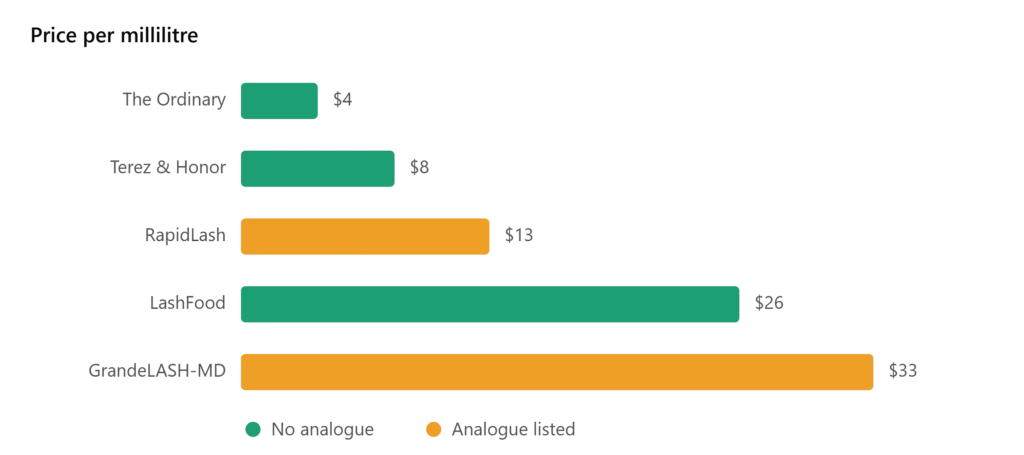
At around $15 for 5mL, this is roughly $3 per millilitre. GrandeLASH-MD runs about $33 per millilitre. LashFood is around $26. On sticker maths, nothing else is close.
But there’s a wrinkle nobody accounts for: this is a twice-daily product. Morning and evening, per the directions. Almost every prostaglandin serum is once daily.
So the tube empties roughly twice as fast as the per-millilitre figure suggests. A 5mL tube used morning and night lasts around eight to nine weeks, which works out near $7.50 a month. Still the cheapest serious option on the market by a distance — GrandeLASH-MD sits around $22 a month — but the gap is three-fold, not ten-fold.
One practical note that costs people money: the 5mL tube has no click-stop mechanism. The brush pulls straight out, and it’s easy to load far more product than you need. A thin coat along the upper lash line is enough.
Buy from The Ordinary directly, Sephora, Ulta or another authorised seller. Counterfeit Ordinary products are widespread, and a fake makes this entire page irrelevant.
Against a prostaglandin serum
If you’re weighing this against GrandeLASH-MD, RapidLash or NeuLash, the trade-off is clean.
Prostaglandin analogues extend the growth phase at the follicle. That produces genuine length, faster, and it comes with a documented risk profile — iris pigmentation, fat loss around the eye socket, eyelid darkening — plus a Health Canada restriction and an EU scientific opinion finding the class cannot be considered safe in cosmetics.
Peptides support the lash that’s already there. Less breakage, better density, no analogue on the label, and a smaller change that takes longer to appear.
The choice isn’t really cheap versus expensive. It’s whether you want a pharmacologically active ingredient near your eye. If you have blue, green or hazel eyes, are pregnant, or are being treated for glaucoma, that question is already settled for you.
Lashes and brows from one tube
This is one of very few products formulated and sold for both, and it changes the value equation — you’re buying two products’ worth of use.
Practically, brow skin tolerates more than the lash line. A formula safe for lashes is automatically safe for brows; the reverse isn’t true. That’s why lash-first formulation matters.
Apply differently, though. Lashes: a thin line along the upper lash base, like liquid liner. Brows: work into the skin along the brow, where the follicles are, not over the hairs. Brows also tend to respond faster, since brow hair cycles differ from lash hair cycles.
What buyers consistently report
Across published reviews at Ulta, Amazon and Sephora, three patterns recur.
- The positives. Comfort is the most consistent theme — very few reports of stinging or burning, which tracks with the near-neutral pH and the absence of alcohol and fragrance. Brow results come up more often and more enthusiastically than lash results. And people who set out to maintain what they had, rather than transform it, are the most satisfied group by a clear margin.
- The complaints. Slow is the word that appears most. Reviewers describing dramatic change are rare, and several who compared it against a prostaglandin serum they’d used previously found it noticeably weaker. Remembering it twice a day defeats a fair number of people. And a recurring note that the effect is subtle enough to be hard to see in a mirror while being visible in side-by-side photos.
- One outside data point worth having. An independent review site running its own small panel reported first visible changes around weeks eight to ten — not the four weeks the packaging suggests. Three people isn’t evidence, but it points the same direction as the review body: this is slower than the label implies.
Common questions
Does The Ordinary lash serum work?
For density and reduced breakage, the evidence supports a modest effect and the review record agrees. For length, the brand makes no such claim and you shouldn’t expect one. It’s a maintenance product that happens to be cheap, not a cheap version of a growth serum.
Is The Ordinary lash serum prostaglandin free?
Yes. The brand states it contains no prostaglandins, and the ingredient list checked on 5 August 2026 carries no analogue name. Every name to check for →
How long does it take to work?
The packaging says as little as four weeks. Published reviews and independent panels point closer to eight to ten. Twice-daily use, without gaps, is the variable that matters most.
Is it good for sensitive eyes?
The formula avoids the usual culprits — no fragrance, no denatured alcohol, no formaldehyde releasers — and its pH sits near tear film. That’s a good starting point, though no formula can guarantee your eye won’t react.
Can I use it on my brows?
It’s formulated for both. Apply into the skin along the brow rather than over the hairs, and expect brows to respond sooner than lashes.
Is it worth it?
At around $7.50 a month it’s the lowest-cost way to find out whether a peptide serum does anything for you. If it doesn’t, you’ve spent less than one tube of most alternatives. If you already know you want visible length quickly, buying this first will only cost you three months.