Every Prostaglandin Analogue Name in Lash Serums (2026)
If you have a bottle in your hand, use the table below. Find the ingredient name on your label, read across for what it is and where regulators stand. If your name isn’t listed, skip to the morpheme rule at the bottom — it catches names that don’t exist yet. All entries checked 5 August 2026.
The complete name table
| Name on the label | Also written as | What it is | Listed on | Regulatory position |
|---|---|---|---|---|
| Bimatoprost | — | Prescription drug substance | Latisse, Lumigan | FDA-approved. Prescription only |
| Isopropyl cloprostenate (IPCP) CAS 157283-66-4 | Cloprostenol isopropyl ester | Synthetic prostaglandin F2-alpha analogue | GrandeLASH-MD, RapidLash, NeuLash, Nulastin, Babe Original, UKLash, Rodan + Fields Lash Boost | Health Canada Hotlist. FDA warning letter 2011. SCCS: not safe |
| Cloprostenol isopropyl ester | Isopropyl cloprostenate | Same substance, alternative naming | Babe Original Essential; Nulastin’s Amazon listing | As above |
| Dechloro dihydroxy difluoro ethylcloprostenolamide (DDDE) CAS 1185851-52-8 | Ethyl tafluprostamide | Analogue derived from tafluprost. 50 characters with spaces | RevitaLash Advanced | SCCS: not safe |
| Ethyl tafluprostamide | DDDE | Same substance under a shorter name | Reformulated cosmetic serums | SCCS: not safe |
| Methylamido-dihydro-noralfaprostal (MDN) CAS 155206-01-2 | — | Analogue | NutraLuxe Lash MD, per its last published list | SCCS: not safe |
| Norbimatoprost | — | Analogue related to bimatoprost | M2 Beaute Eyelash Activating Serum | No specific cosmetic ruling |
| Dehydrolatanoprost | — | Analogue related to latanoprost | Obagi Nu-Cil | No specific cosmetic ruling |
| Trifluoromethyl dechloro ethylprostenolamide | — | Analogue | Appears in newer formulas | No specific cosmetic ruling |
| Latanoprost | — | Prescription glaucoma drug | Xalatan | Prescription only |
| Travoprost | — | Prescription glaucoma drug | Travatan | Prescription only |
| Tafluprost | — | Prescription glaucoma drug; parent of ethyl tafluprostamide | Zioptan | Prescription only |
| Prostaglandin F2-alpha | Dinoprost | The parent molecule the whole class derives from | — | Not used directly in cosmetics |
Reading the regulatory column. “SCCS: not safe” refers to Opinion SCCS/1680/25, adopted 2 February 2026, which concluded these substances cannot be considered safe in lash and brow growth cosmetics. That is a scientific opinion. EU law is unchanged and these products remain on sale.
“Health Canada Hotlist” means the substance appears on the Cosmetic Ingredient Hotlist, which restricts or prohibits use in cosmetics sold in Canada.
“No specific cosmetic ruling” means no regulator has assessed that individual substance for this use. It does not mean it has been cleared.
What the ingredient order tells you
Ingredients appear in descending order of concentration, but only down to 1%. Below that threshold, a manufacturer can list in any order they choose. That single rule explains most of what confuses people about these labels.
- The first three to five names are the base. Water, glycerin, butylene glycol, a thickener. These make up the bulk of what’s in the tube and tell you almost nothing about what the product does.
- The 1% line is invisible, and you have to infer it. Preservatives are used at low concentrations — phenoxyethanol at up to 1%, sodium benzoate and potassium sorbate lower still. When you reach the first preservative, everything from roughly there onward is below 1%.
- Actives sit in different places depending on the class. Peptides work at very low concentrations, so a peptide near the middle of a list can still be doing real work. Analogues work at concentrations lower again — the SCCS assessed isopropyl cloprostenate at 0.005%, which places it far down any label. Its position is not a measure of its effect.
That last point matters more than any other on this page. An analogue appearing second-to-last is not a trace contaminant. It is the pharmacologically active ingredient, present at the concentration it was designed to work at.
Why one substance carries several names
The same molecule can appear on labels under different names, and this is not deception — it is how chemical nomenclature works. Understanding why makes the table above easier to use.
- INCI names and chemical names diverge. The International Nomenclature of Cosmetic Ingredients assigns a standardised name for labelling. A chemist describing the same molecule structurally may write it differently. Isopropyl cloprostenate and cloprostenol isopropyl ester are the same compound named from two directions — one leading with the alcohol group, one with the acid.
- Regional labelling differs. A product sold in the US, the EU and Canada may carry three ingredient lists with three naming conventions. CosIng, the European Commission’s cosmetic ingredient database, is the reference for EU labelling.
- Descriptive names replace systematic ones. DDDE and ethyl tafluprostamide describe the same substance. One is a fifty-character structural description; the other names its parent drug. Both are accurate.
The practical consequence: searching one name will not find the others. If you’re checking a product against this list, read every unfamiliar name in the ingredient list rather than searching for the one name you already know.
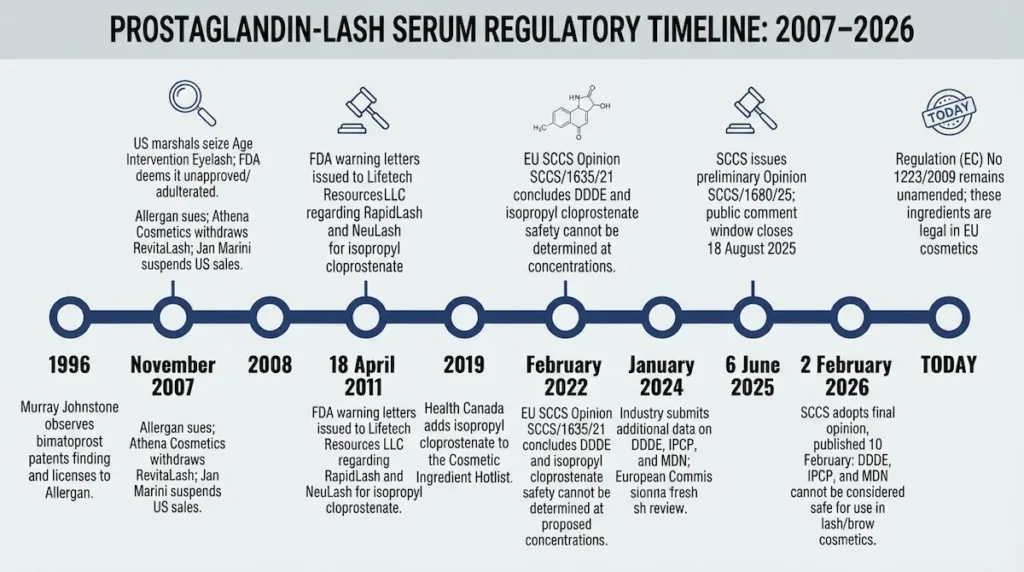
The regulatory record, 2007 to 2026
- 1996. Glaucoma specialist Murray Johnstone observes that patients using bimatoprost solutions grow longer lashes. He patents the finding and licenses it to Allergan.
- November 2007. US marshals seize more than 12,000 tubes of Age Intervention Eyelash from Jan Marini Skin Research, valued at $2 million, at the FDA’s request. The agency describes it as an unapproved and misbranded drug because of its growth claims, and an adulterated cosmetic because it contains bimatoprost. Cited concerns: optic nerve damage, macular oedema and uveitis, particularly in people already using bimatoprost for glaucoma.
- November 2007. Allergan sues seven companies over bimatoprost-containing lash products. Athena Cosmetics withdraws RevitaLash from the market. Jan Marini suspends US sales.
- 2008. The FDA approves Latisse (bimatoprost 0.03%) for inadequate eyelashes — the only such approval to date.
- 18 April 2011. The FDA issues a warning letter to Lifetech Resources LLC covering RapidLash Eyelash Renewal Serum, NeuLash Active Eyelash Technology and NeuveauBrow. The basis is both the growth claims and the presence of isopropyl cloprostenate. The agency finds the products to be unapproved new drugs under sections 505(a) and 301(d) of the Federal Food, Drug and Cosmetic Act, and misbranded drugs under section 502.
- 2019. Health Canada adds isopropyl cloprostenate to the Cosmetic Ingredient Hotlist.
- February 2022. The EU’s SCCS publishes Opinion SCCS/1635/21, examining DDDE and isopropyl cloprostenate. It concludes it cannot determine that either is safe at the concentrations proposed — 0.006% and 0.007% for IPCP, 0.018% for ethyl tafluprostamide.
- January 2024. Industry submits additional data on DDDE, IPCP and MDN. The European Commission mandates a fresh review.
- 6 June 2025. The SCCS issues preliminary Opinion SCCS/1680/25, with a public comment window closing 18 August 2025.
- 2 February 2026. The SCCS adopts its final opinion, published 10 February. All three substances cannot be considered safe for lash and brow growth cosmetics. No lower concentration could be identified as safe.
- Today. Regulation (EC) No 1223/2009 remains unamended. These ingredients are legal in EU cosmetics.
A parallel record exists in the US civil courts rather than the regulatory system. Class action settlements have been reached with Grande Cosmetics, Rodan + Fields, Elixir Cosmetics over Babe Lash, and Athena Cosmetics over RevitaLash — the last covering two consolidated cases with a final approval hearing set for May 2026. The common allegation across them is inadequate disclosure of a drug-class ingredient, not proven injury.
The rule that outlasts this list
New names enter this category faster than any table can track. Three of the names above did not exist commercially fifteen years ago. So learn the pattern rather than the list.
Any ingredient name containing prost, prostenol, prostenate or prostamide belongs to the prostaglandin analogue class.
Test it against the table. Isoproprostenate. Cloprostenol. Ethylcloprostenolamide. Nor bimatoprost. Dehydrolatanoprost. Ethyl tafluprostamide. Every one contains a fragment.
The fragment survives reformulation because it comes from the underlying chemistry, not the marketing. A brand can rename an ingredient. It cannot remove the structural feature that makes the name what it is while keeping the molecule that works.
Two cautions on using it. The rule identifies the class; it does not tell you the concentration or the risk for you personally. And it produces occasional false positives on unrelated chemistry — check the full name against the table above before concluding.
FAQs
What are prostaglandin analogues?
Synthetic compounds structurally related to prostaglandins, lipid signalling molecules the body produces. In lash products they act on the hair follicle to extend the phase in which a lash actively grows. The class originated in glaucoma medicine, where lash growth appeared as a side effect.
What names do they hide under on a label?
Thirteen are listed in the table above. The most common in cosmetics is isopropyl cloprostenate. The hardest to spot is dechloro dihydroxy difluoro ethylcloprostenolamide, which runs to fifty characters and reads like a chemical the eye slides past.
Is bimatoprost the same as Latisse?
Bimatoprost is the drug substance; Latisse is the brand name of the FDA-approved 0.03% ophthalmic solution for inadequate lashes. The same substance at different concentrations is sold as Lumigan for glaucoma.
Are these ingredients banned anywhere?
Isopropyl cloprostenate appears on Health Canada’s Cosmetic Ingredient Hotlist. Nowhere else has a prohibition in force. The EU’s February 2026 opinion found three substances unsafe but has not changed EU law.
Did the EU ban prostaglandin lash serums in 2026?
No. The SCCS issued a scientific opinion, which is advice to the European Commission, not a legal restriction. Regulation (EC) No 1223/2009 is unamended and these products remain on sale in the EU.
Which lash serums contain them?
The products column in the table above lists what we found on labels checked 5 August 2026. Formulas change without announcement — verify against the current package before you rely on any entry.