Is GrandeLASH-MD Safe? What the Label Actually Says
GrandeLASH-MD contains isopropyl cloprostenate, a synthetic prostaglandin analogue. That single fact answers most of what people arrive here asking. It explains why the product works faster than peptide serums, why Health Canada restricts the ingredient, why the EU’s scientific committee assessed it in 2026, and why Grande settled a $6.25 million class action over how it was disclosed.
None of that makes it dangerous for you specifically. It does mean the decision deserves five minutes rather than a star rating.
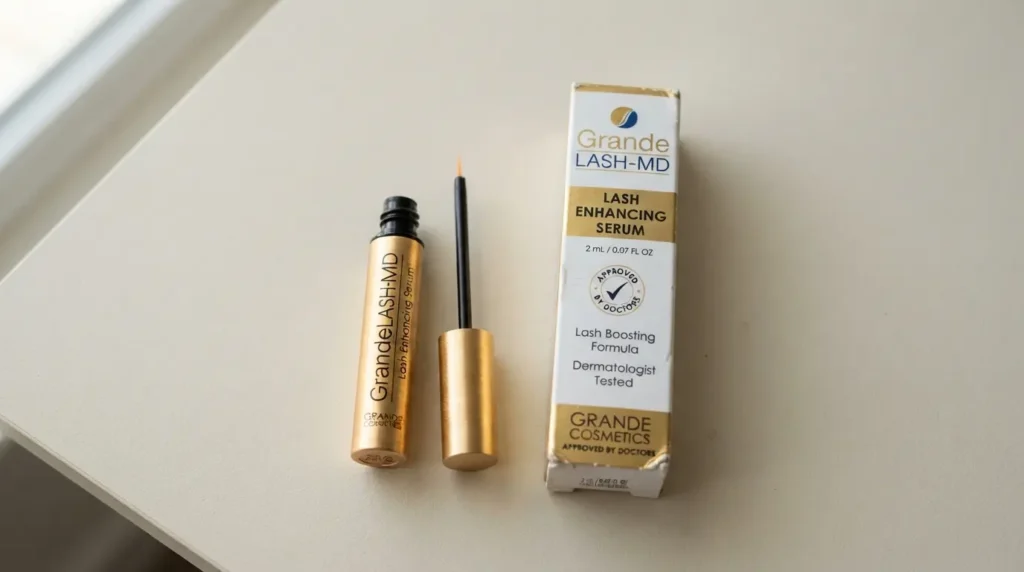
What’s on the label
Checked at grandecosmetics.com on 5 August 2026:
Water, panthenol, glycerin, sodium citrate, Leuconostoc/radish root ferment filtrate, alanine, alcohol, aloe barbadensis leaf juice, Arctostaphylos uva-ursi leaf extract, arginine, aspartic acid, calcium gluconate, caprylyl glycol, Chamomilla recutita flower extract, ethylhexylglycerin, gluconolactone, glycine, hexylene glycol, histidine, honey extract, hydrolyzed glycosaminoglycans, hydrolyzed yeast extract, hydroxyethylcellulose, isoleucine, isopropyl cloprostenate (an analog of prostaglandin), magnesium ascorbyl phosphate, Panax ginseng root extract, PCA, phenylalanine, polysorbate 20, proline, propylene glycol, serine, sodium hyaluronate, sodium lactate, sodium PCA, threonine, tocopheryl acetate, triethanolamine, Tussilago farfara leaf extract, valine, Vitis vinifera seed extract, phenoxyethanol, sodium benzoate, sodium metabisulfite.
Two things to notice.
The list after the first five names runs alphabetically, not by concentration. That’s permitted below the 1% threshold, and it means the analogue’s position tells you nothing about how much is in the tube. It sits between isoleucine and magnesium ascorbyl phosphate because of the letter I, not because of its dose.
And alcohol appears seventh. If your eyes sting with most eye-area products, that’s a more likely cause of day-one irritation than the analogue.
The supporting cast is genuinely well chosen: radish root ferment, sodium hyaluronate, grape seed extract, a full set of amino acids, honey and aloe. This is not a cheap formula with one active carrying it.
Why that parenthetical is there
The words “an analog of prostaglandin” sit in brackets after the ingredient name on Grande’s site and at Ulta. Most brands don’t do that. It looks like unusual candour.
It came out of a lawsuit.
In Nixon v. Grande Cosmetics, LLC, filed in the District of New Jersey in November 2022, the plaintiff alleged Grande failed to disclose material information about isopropyl cloprostenate in GrandeLASH-MD, GrandeBROW and GrandeHAIR. The court granted preliminary approval on 14 December 2023, with a fairness hearing on 13 March 2024. The settlement fund was $6.25 million, paying up to $150 per claimant without proof of purchase and up to $300 with proof of two purchases. Class members were reporting payments through 2026.
Grande denied wrongdoing throughout and still does. Its own lawsuit page states the case did not relate to personal injuries, and that the company agreed to enhance labelling — including, in its words, updated usage instructions and wording within the ingredient list.
That’s the parenthetical. The disclosure is real and it’s useful, and it arrived as a settlement term rather than a decision the brand reached on its own. Both halves of that are worth knowing.
Note also what the case was and wasn’t. It was a disclosure claim. No court found the product unsafe, and no injury was established.
What regulators have actually said
Health Canada lists isopropyl cloprostenate on its Cosmetic Ingredient Hotlist, which restricts or prohibits substances in cosmetics sold in Canada. Products listing it are not legitimately sold there.
The FDA has not approved any cosmetic containing this ingredient, because cosmetics don’t require approval. It has acted on the ingredient before: in April 2011 it issued a warning letter to Lifetech Resources covering RapidLash and NeuLash, finding products containing isopropyl cloprostenate to be unapproved new drugs and misbranded drugs. That letter targeted a different manufacturer, not Grande.
The EU’s SCCS adopted Opinion SCCS/1680/25 on 2 February 2026, concluding that isopropyl cloprostenate cannot be considered safe in lash and brow growth cosmetics, and that no lower concentration could be identified as safe. It is an opinion, not a ban. EU law is unchanged and the product remains on sale there.
What none of these bodies has said: that GrandeLASH-MD has injured anyone, or that the concentration Grande uses is harmful. The regulatory concern is about the ingredient class and the absence of data, not about documented harm from this product.
Grande’s three arguments, tested
Grande publishes a rebuttal page and has given statements to press. Three arguments recur.
“Isopropyl cloprostenate and bimatoprost have completely different structures and activities.”
Their structures do differ. Their activities are the harder claim. Both are agonists at the FP prostaglandin receptor, and both extend the lash growth phase through that pathway — which is precisely why both grow lashes. Two molecules acting on the same receptor to produce the same effect are not doing completely different things. The claim is defensible on structure and strained on activity.
“It’s classified by INCI as a hair conditioning agent.”
Accurate, and it settles nothing. INCI is a naming dictionary that records what an ingredient is used for. It performs no safety assessment. The SCCS looked at the same substance and reached a conclusion about a different question.
“An eight-month third-party study of 120 users found no iris colour change or orbital fat loss.”
This is their strongest card and it is worth taking seriously — most cosmetic brands in this category fund nothing at all.
Judged against what would make it conclusive, it falls short in four places. No control arm is described. No standardised iris photography protocol is published. The eye-colour composition of the 120 participants isn’t given, and iris darkening concentrates in light irides, so a mostly brown-eyed cohort couldn’t detect it. And eight months may be too short: the FDA’s bimatoprost labelling notes iris changes may take months to years to become noticeable.
There’s also no journal, DOI, protocol or named research organisation attached, so nobody outside Grande can examine it.
Where that leaves you. The study is a real signal that a brushed-on cosmetic dose behaves differently from a daily glaucoma drop. It is not evidence that the risk is absent, and it wasn’t enough to persuade the SCCS, which reviewed industry data through 2025 and 2026 and still declined to clear the ingredient.
GrandeLASH-MD or Latisse
People compare these two because they work the same way. The differences that matter aren’t about the molecule.
| GrandeLASH-MD | Latisse | |
|---|---|---|
| Active | Isopropyl cloprostenate | Bimatoprost 0.03% |
| Legal status | Cosmetic | FDA-approved prescription drug |
| Evidence required before sale | None | Phase 3 trials |
| Published trial data | One unpublished brand study | 278 participants, 16 weeks, standardised photography |
| Who supervises you | Nobody | A prescriber |
| Documented side effects on the label | Use warning only | Full adverse reaction profile |
| Cost | Around $22/month | Around $130/month |
Latisse is the better-evidenced product by a wide margin and the more expensive one by a factor of six. GrandeLASH-MD is the same mechanism sold without the trial data, the label warnings or the supervision.
If you’ve decided you’re comfortable with this ingredient class, the honest question isn’t which brand — it’s whether you’d rather take it with a clinician watching your intraocular pressure and iris colour, or without.
What it costs to keep using it
| Size | Listed as | Price | Cost per month |
|---|---|---|---|
| 1mL | 6-week supply | $36 | ~$26 |
| 2mL | 3-month supply | $65 | ~$22 |
| 4mL | 6-month supply | Varies by retailer | ~$20 at typical pricing |
Walmart has listed the 3-month size between $49.98 and $53.99 against a $68 reference price, so the number you pay depends heavily on where you buy.
The figure people miss is the ongoing one. Lashes return to baseline within a couple of growth cycles after stopping, so this is a subscription in everything but name. At the 2mL size on daily use, that’s roughly $260 a year, dropping to around $160 once you move to the every-other-day maintenance Grande recommends after the first three months.
Buy from Grande directly, Sephora, Ulta or another authorised retailer. This is among the most counterfeited products in the category, and a fake makes every word on this page irrelevant.
Reported side effects
From published sources, not our own testing. The FDA’s 2011 warning letter on isopropyl cloprostenate products cited ocular irritation, hyperemia, iris colour change, macular oedema and ocular inflammation. Grande’s own guidance acknowledges an acclimation period and advises sensitive users to apply every other night for the first fortnight.
Grande’s application instructions matter more than most people realise: upper lash line only, one stroke, one dip for both eyes, two to three minutes to dry. Applying to the lid rather than the lash line is what drives eyelid darkening, and applying to the lower lash line increases contact with the eye itself.
If you’d rather not use this ingredient
Three formulas whose labels carry no analogue, checked the same day:
- The Ordinary Multi-Peptide Lash & Brow, around $20 for 5mL. Four peptide complexes, no fragrance, no denatured alcohol. Roughly a fifth of the monthly cost.
- Vegamour GRO, 3mL. Botanical actives, and the brand publishes both sample size and duration behind its claim.
- LashFood Phyto-Medic, $78 for 3mL. Ecocert certified, alcohol-free and fragrance-free — the gentlest label here.
FAQ
Does GrandeLASH-MD contain prostaglandin?
It contains isopropyl cloprostenate, a synthetic prostaglandin analogue. Grande’s own label names it as an analog of prostaglandin in brackets after the ingredient.
Is GrandeLASH-MD banned in Canada?
The ingredient appears on Health Canada’s Cosmetic Ingredient Hotlist, so products listing it aren’t legitimately sold in Canada. That’s a restriction on the ingredient, not a recall of the brand.
Why does the label say “an analog of prostaglandin” now
That wording came from the settlement of Nixon v. Grande Cosmetics. Grande agreed to enhance labelling, including the wording within the ingredient list, while denying any wrongdoing.
Can I use it if I’m being treated for glaucoma?
Speak to your ophthalmologist first. Prostaglandin analogues can interfere with the intraocular pressure control you’re relying on — the Latisse label states this explicitly for bimatoprost, and the mechanism is shared.